Marsh Birds of the UK: A Guide to Bitterns, Bearded Tits and Water Rails
Reedbeds have a reputation for being quiet. They are not. Wind clatters through the stems, moorhens squabble, a Cetti's warbler fires off three notes and vanishes again. Yet three of Britain's most wanted marsh birds live in that same tangle almost invisibly, and two of them you will hear long before you ever see one. Bitterns, bearded tits and water rails all depend on wet, dense vegetation, and all three reward patience far more than chasing. Learn their voices, pick the right season, and an apparently empty reedbed starts throwing out clues.
Why these birds are so hard to see
Reed and sedge grow vertically, which means the cover is total. A bittern standing still is a brown-striped column among brown-striped columns. A water rail walks beneath the stems on floating rafts of dead vegetation, using tunnels it knows and you cannot see.
Three things tip the odds in your favour: work the edges, where water meets a cut channel or an open pool; choose calm, dry, high-pressure mornings; and stay put. Most visitors move on after ten minutes. Twenty minutes of stillness is usually when the marsh decides you are furniture.
The bittern: a boom you feel before you hear
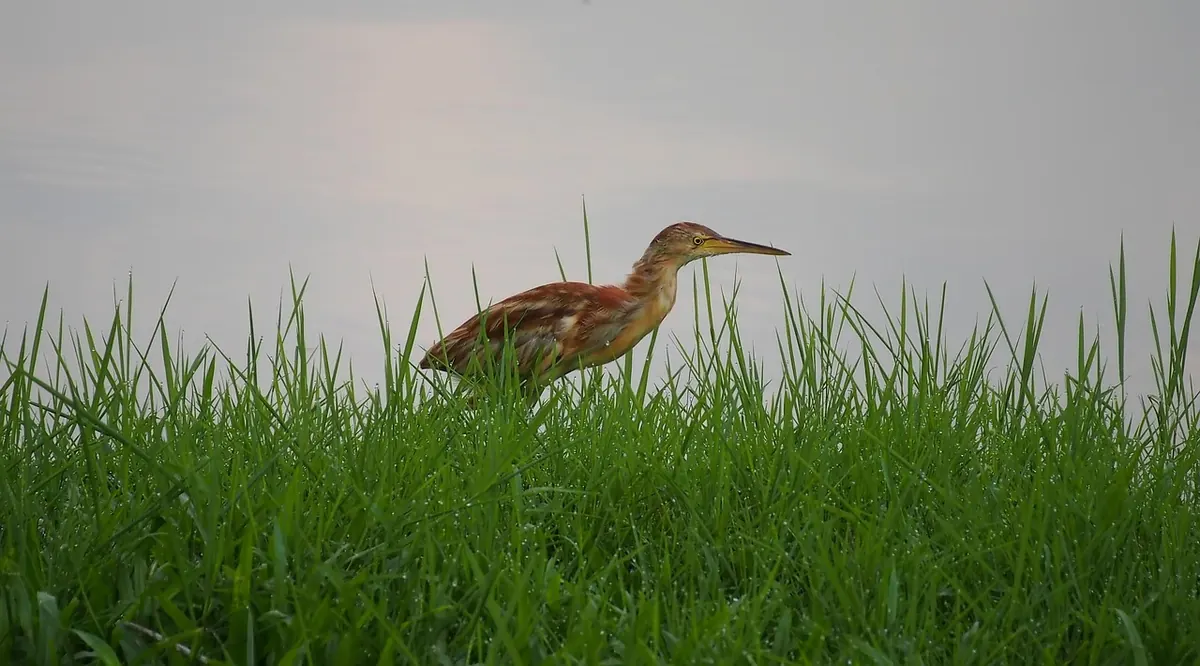
A bittern is a stocky, secretive heron built for concealment, streaked in buff and dark brown so that its outline dissolves against the reeds. Disturbed, it will freeze with its neck stretched and bill pointed skyward rather than fly. When you do see one properly — usually in flight, or hunched at the edge of ice — it looks oddly heavy, with broad wings, a short neck and trailing feet.
The boom
In late winter and spring, males produce a deep, resonant boom, often described as the sound of someone blowing across the top of a milk bottle, but vast and slow. It carries well over a kilometre on still air, and it sits so low in the frequency range that many people feel it in the chest before they register it as sound. A male bittern has an enlarged windpipe that acts as a resonating chamber, which is how a bird this size produces a note like a distant ship's foghorn.
When and where
Booming runs roughly from late February into April, peaking in March and the first half of April once the ice has cleared. Early morning is the classic window, with a second burst at dusk. Winter, paradoxically, is the best time to actually watch bitterns, because frost and ice push them out of the densest cover and into the open. Large, well-managed reedbeds are the places to try: Minsmere in Suffolk, Leighton Moss in Lancashire, Stodmarsh in Kent, Ham Wall on the Somerset Levels, Ouse Fen in Cambridgeshire, Newport Wetlands in south Wales.
Bearded tits: the ping in the reeds
Bearded tits are properly called bearded reedlings, since they are neither tits nor bearded. They are small, tawny and long-tailed, bouncing in undulating flight across the tops of the reeds. The male wears a bold black moustache and a grey head; the female is plainer, buff-brown with a paler belly.
Their call is the giveaway. It is a metallic, bell-like ping, given constantly by birds keeping contact as they move. Learn that one sound and you will find bearded tits in reedbeds where you would otherwise have sworn there was nothing at all.
Late summer through winter is the best period. Family parties gather into flocks, and in autumn the birds climb the stems to feed on reed aphids before switching to seeds later in the year. Hard winters and tidal flooding can hit them badly, so populations rise and fall. Still, calm mornings in October and November, with the sun low and the reeds lit up, are hard to beat. Try Blacktoft Sands, Strumpshaw Fen, Leighton Moss, Titchwell or Radipole Lake in Dorset.
Water rail: the piglet in the sedge
The water rail is the shyest of the three. Slim, narrow-bodied and built to slip through gaps, it has a slate-blue face and breast, brown-streaked upperparts, a red bill and ridiculously long toes for walking on floating vegetation. Most sightings last two seconds: a bird crossing a muddy channel between reed stems, then gone.
Its voice is extraordinary. The "sharming" call is an explosive, repeated squeal, very like a piglet in distress — once heard, never forgotten, and nothing else in a British reedbed sounds quite like it. There is also a short, clipped kipp, often written down as sounding like a coin tapped on a table.
Winter is when rails are most visible, because freezing weather forces them out of cover to the last patches of open water. They are also at their most vocal in autumn and again from February into May. Position yourself in a hide looking down at a small muddy ditch rather than out across a big expanse of reed, and your chances improve dramatically.
Seasons at a glance
- Late February to April: the peak. Bitterns booming at dawn, water rails sharming, bearded tits pairing and calling constantly.
- May to July: the quiet months. Adults are feeding young and keeping their heads down.
- August and September: bearded tit family parties climb the reeds to feed on aphids and are unusually easy to watch.
- October and November: reed-cutting on many reserves pushes water rails into the open; bearded tit flocks wander widely.
- December to February: the best months for actually seeing bitterns and rails, as ice concentrates them at open water.
How to listen properly
- Time it right. Dawn, the hour around it, and dusk are when bitterns and rails make themselves heard.
- Check the wind. Choose a still day or a spot with the breeze at your back. These are low, soft calls and wind noise will swallow them.
- Stand still and close your eyes for two minutes. It resets your hearing and makes faint calls far easier to pick out.
- Learn three sounds before you go, using recordings at home. Do not use playback in the field: it disturbs the very birds you came to see and can pull territorial males away from feeding or nesting duties.
- Note what you hear. Time, direction, weather, and whether the call repeated. After a few visits, patterns emerge and you stop second-guessing yourself.
- Ask locally. Reserve staff and the sightings book will tell you which compartment a bittern has been using that week.
Planning a visit that works
Wear wellingtons or waterproof boots, take binoculars you are comfortable holding for an hour,
Photo: vinsky2002 / Pixabay